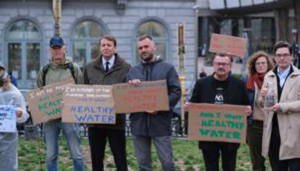
 On Monday, 23 September 2025, the European Anglers Alliance (EAA) joined NGOs, scientists, and MEPs in Brussels to warn against weakening EU water pollution rules during the final trilogue negotiations on the list of priority pollutants for surface and ground water.
EU strikes deal on water pollution, but existing protections pay the price
On 23 September 2025, The EU institutions have reached a long-awaited deal on updated rules for pollution of EU surface and groundwater, but Member States have managed to delay and weaken obligations.
While the deal requires Member States to monitor and limit pollution of new substances, among them more pesticides (including glyphosate), a group of PFAS, and – for the first time – pharmaceuticals, Member States managed to secure long timelines to act. Member States have until 2039, with the possibility to delay until 2045, to comply with the new standards.
While close to 200,000 people recently raised their voice against deregulation of environmental laws, the deal included Member States’ (and some industry’s) wish to weaken the non-deterioration principle of the WFD, by the introduction of two new exemptions that allow short term negative impacts, and deterioration of status following relocation of water or sediment.
Anglers’ concerns voiced to policymakers in front of the EU Parliament in Brussels
Before the conclusion of this deal, NGOs, water associations, scientists, and civil society came together in Brussels to deliver a stark warning: Europe cannot afford weaker water laws. The event included – besides a delegation of the European Anglers Alliance (EAA) – representatives of The European Environmental Bureau (EEB), Health Care Without Harm, WWF, PAN-Europe and Surfrider Europe.
The event underlined why Europe needs stricter implementation of water laws to protect public health and the environment.
Representing the European Anglers Alliance, David Vertegaal of Sportvisserij Nederland highlighted how pollution and climate pressures combine to damage rivers and fish populations. In his speech, David Vertegaal outlined the case of eel pollution as in large parts of The Netherlands, this species may not be consumed due to high pollution with PCB’s (Polychlorinated biphenyl) and dioxins. In addition to this, David outlined the recent PFAS pollution case in the Scheldt estuary. This has had disastrous impacts on fish consumption, as the commercial fisheries sector is now banned in large parts of the Western Scheldt area, while anglers have been warned not to eat their catch, affecting over 10 % of the sea angling community in The Netherlands! This is a clear example of how Europe has not been able to stop pollution from happening despite the Water Framework Directive, underlined David.
To conclude his speech, David stressed that “Fish need clean water during their life cycle and therefore anglers need it too. Our sector is engaged in reintroduction of endangered species such as sturgeon and salmon, but we need clean water for that to stand a chance to be successful”.

Photo credits: European Environmental Bureau (EEB) – 2025
EAA’s message was delivered directly to Members of the European Parliament Michal Wiezik (Renew Europe, Slovakia), Javi Lopez (S&D, Spain), and Per Clausen (The Left, Denmark), all present at the event. David also took the opportunity to speak personally with MEP Mr Michal Wiezik, co-Chair of the European Parliament Forum on Recreational Fisheries and Aquatic Environment, ensuring that the concerns of Europe’s anglers are taken into account in the legislative debate.

Photo credits: Aliénor, 2025
EAA called for Europe’s ambition to protect our waters
With this stunt in front of the European Parliament, together with partners, the EAA urged Europe’s policymakers to listen to scientists, anglers, and civil society. Tackling water pollution is a no-brainer: freshwater is a unique resource, indispensable not only for Europe’s stability and prosperity, but also for businesses to operate and for nature to thrive.
The European Anglers Alliance has long been engaged in the implementation of the Water Framework Directive (WFD), including through its work in the European Parliament Forum on Recreational Fisheries and Aquatic Environment. The WFD is designed to protect and restore EU rivers, lakes, wetlands, groundwaters, transitional waters such as estuaries and lagoons, as well as man-made water bodies like canals and docks.
For anglers, healthy waters and abundant fish stocks are fundamental. As some of the most attentive observers of aquatic ecosystems, anglers are often the first to detect a decline in water quality or biodiversity. This is why full and ambitious implementation of the WFD is critical — to ensure fish migration, safeguard aquatic biodiversity, and maintain thriving fish populations for future generations.
In April 2025, the European Anglers Alliance (EAA) co-signed a joint open letter with 16 other public and private entities — including drinking water and wastewater service providers, environmental NGOs, healthcare professionals, social partners, businesses dependent on clean water, and local authorities. The letter expressed deep concern over the slow progress in adopting new EU water pollution standards.
👉 Read the joint press release by the event organisers on the outcomes of the trilogue meeting here

Photo credits: European Environmental Bureau (EEB) – 2025

Photo credits: European Environmental Bureau (EEB) – 2025